
Sigenergy solar system: four weeks without a single real kilowatt-hour from the grid
My first four weeks with a Sigenergy solar setup, a SigenStor battery and a Home Assistant hookup over Modbus TCP: why I am not pulling a real kilowatt-hour from the grid right now, and where the catch is.
Published · July 23, 2026
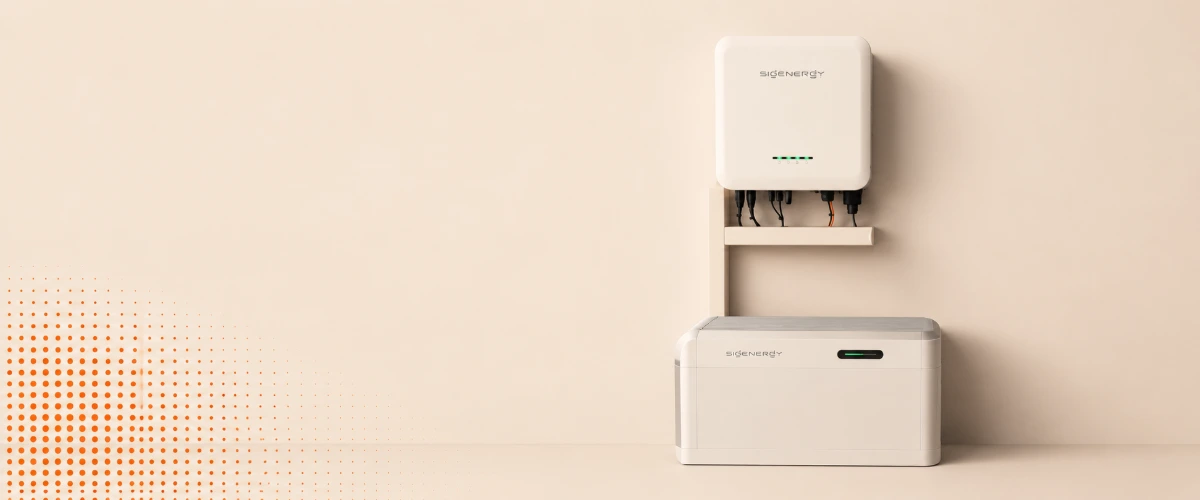
I have had solar panels on the roof for four weeks now.
And for four weeks I have had a slightly embarrassing new hobby: the first thing I do in the morning is check how much power my own roof has produced again.
That sounds like a topic for people who enjoy talking about feed-in tariffs and payback periods.
That was my fear, too.
The reality is much more mundane and at the same time far more satisfying: in four weeks I have not pulled a single real kilowatt-hour from the grid.
What is actually on the roof and in the basement
A quick word on the hardware, because this is supposed to be good stuff, not just a feeling.
On the roof there are 30 modules totaling almost 14 kWp. One of them was thrown in for free on top, which gives me a disproportionate amount of joy as a human being.
In the utility room hangs a Sigenergy Sigen hybrid inverter with 12 kW, plus the SigenStor battery with 9 kWh.
The battery is modular, so I could add to it later. Right now the 9 kWh are easily enough to carry the sun from the day into the evening.
Four weeks, not one real kilowatt-hour
The weather is good right now. I have to say that honestly, more on it later.
But at the moment exactly what the glossy brochures promise is actually happening: during the day the roof produces more than we use. The surplus charges the battery. In the evening and at night the house runs off the battery.
Meanwhile the meter for grid consumption basically stands still.
Four weeks without a single real kilowatt-hour I would have to pay for. It feels a little like cheating every single time.
Why Home Assistant makes the difference
The system has its own app, and it is genuinely good. Clear, fast, I see generation, consumption and battery level at a glance.
But the real fun starts once I pull everything into Home Assistant over Modbus TCP.
Suddenly the system is no longer a closed product, but part of my smart home. I do not just see numbers, I can shape my behavior around them.
Dishwasher, washing machine, charging the bigger loads: it all mentally moves into the hours when the roof is producing more than we need anyway. Data turns into behavior, and that is exactly the part that gets addictive.
What I like about it
- Grid consumption stands still. In good weather the power comes entirely from my own roof, directly during the day, from the battery in the evening and at night.
- The app is really good. Generation, consumption and battery at a glance, no tinkering required.
- Modbus TCP in, Home Assistant happy. The system becomes part of the smart home instead of staying an island.
- The battery is expandable. I do not have to decide for eternity today.
The honest limits
Now the part the brochures like to leave out.
It is summer right now. Four weeks without grid power are impressive, but they are also the result of long, bright days.
In winter it will be different. Over a full year, realistic self-sufficiency is closer to around 70 percent, not 100. Physics stays physics, and in December the sun simply shines for shorter and wearier hours.
But there is an honest lever for exactly that: the inverter can react to the price signals of dynamic electricity tariffs. So I can deliberately charge the battery when grid power is cheapest, instead of when it happens to be most expensive.
In summer I do not need this. In winter it is exactly the difference between "power is just expensive" and "power is at least bought cleverly".
On top of that, the obvious point: this is a five-figure investment, in our case around 15,000 euros. It pays off over years, not overnight.
And honestly: the Modbus hookup and the whole Home Assistant part are nerdy. If you just want power from your roof and are happy with the app, you do not need any of it. I enjoy it, but it is optional, not mandatory.
Would I recommend it?
Yes. With a clear head, but without hesitation.
If you have a suitable roof, can think a few years ahead and are willing to carry the five-figure investment, then a system like this is one of the few big purchases that feels right from the first sunny day.
If, on the other hand, you expect the system to make you as self-sufficient in January as in June, you will be disappointed. That is not how it works.
For me, the combination of Sigenergy, the SigenStor battery and Home Assistant has become exactly what I had hoped for.
Not a closed black-box product, but a piece of the house I understand, see and can control.
And watching your own roof make money is, every single time, pretty good stuff.
✦Four weeks, not one real kilowatt-hour from the grid, and a slightly embarrassing new hobby: watching my own roof make money.
More good stuff
 Game Changer
Wispr Flow: Talking to Agents Instead of Enter-Enter-Enter
My experience with Wispr Flow as voice input for long sessions with AI agents, where typing is too slow and I would otherwise just click option A.
Not as a dictation gimmick, but because I finally tell my agent what I actually mean instead of clicking the next-best option. Würd ich wieder kaufen
Ninja Luxe Café Premier: the honest middle ground between a portafilter and a bean-to-cup
My experience with the Ninja Luxe Café Premier: why it is the perfect middle ground between portafilter effort and bean-to-cup mediocrity.
No portafilter theater, no bean-to-cup compromise. The first coffee machine I stopped looking past. Daily Driver
Quooker Cube: expensive, unnecessary, and worth it every single day
My experience living with the Quooker Cube: instant boiling water for tea, chilled sparkling water on tap and whether the steep price is actually worth it.
An absurdly expensive tap that never feels spectacular, and is worth it every single day for exactly that reason.